1903 – 1957 · Budapest · Princeton · Los Alamos
John von Neumann
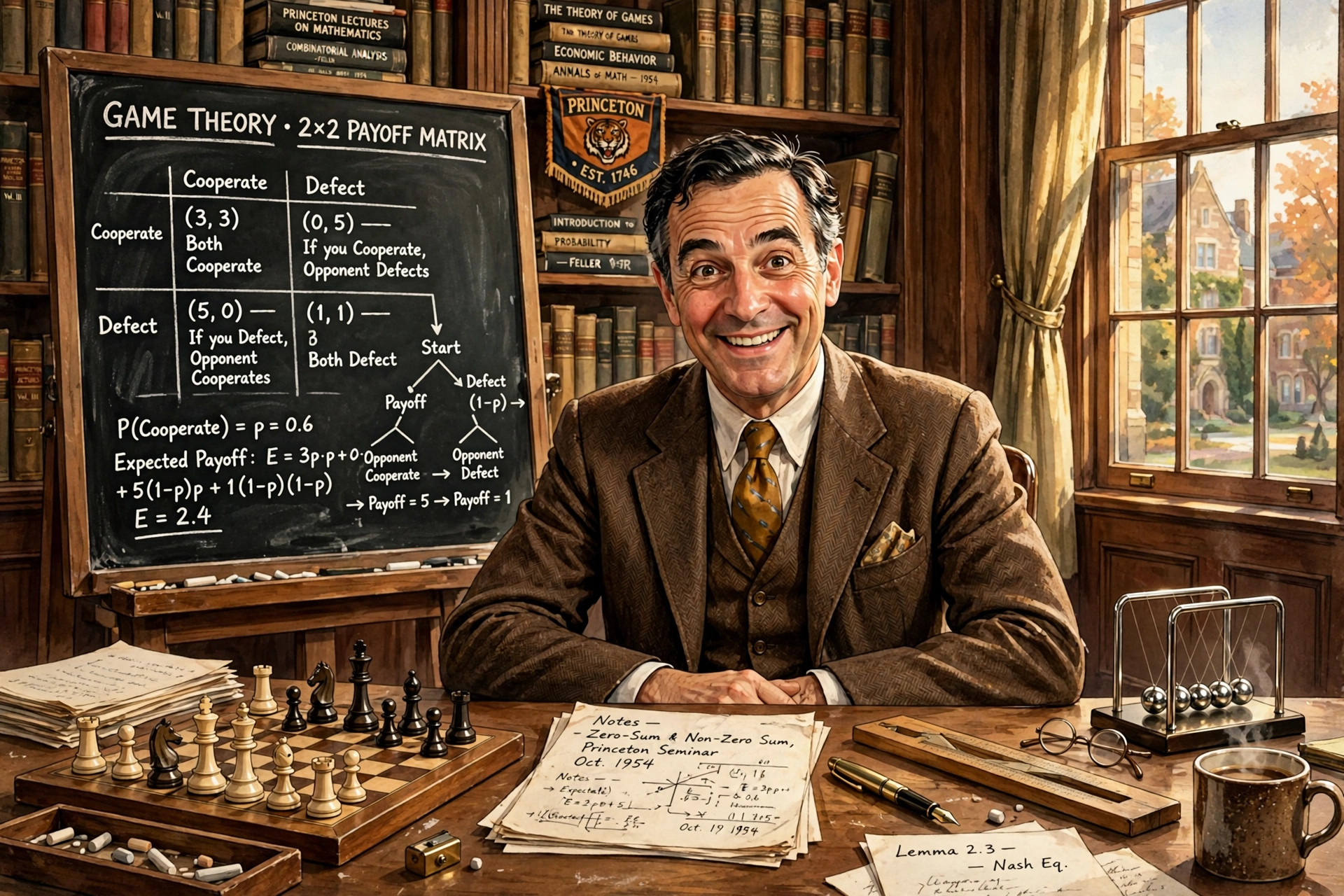
The tenth master, and the science wing's theory chair. John von Neumann founded game theory with a single theorem in 1928, gave quantum mechanics its mathematical foundations, described the stored-program computer the modern world runs on — and did it all quickly, formally, and with jokes that were also proofs. What he teaches here is a method: state the game honestly, name what every player is really after, and compute. In this house he keeps his own fence: he hands you a cleaner problem and a workable strategy — never a verdict from beyond.
Hear his greeting
His recorded greeting to visitors. The voice is type-matched — a quick, precise Princeton professor of his era, fitted by type; recordings of von Neumann's voice exist, and none is imitated.
His books
A strategist's shelf. Theory of Games and Economic Behavior (1944, with Oskar Morgenstern) founded game theory as a discipline — six hundred pages arguing that economics, politics, and war are games, and games can be solved. Mathematical Foundations of Quantum Mechanics (1932) gave quantum theory its rigorous form and is still the foundation under the subject. His 1945 "First Draft of a Report on the EDVAC" is a paper, not a book, but it described the stored-program computer — the architecture in nearly every machine since. And The Computer and the Brain (1958), published unfinished after his death, is his last look forward: what the newest machine and the oldest one might teach each other.
His method
Name the game. Wherever other decision-makers are involved, you are in a game whether you name it or not — the players, their real options, and what each is actually trying to maximise. The other side is optimising too. Theory of Games and Economic Behavior (1944)
Secure the guaranteed outcome. His minimax theorem (1928): in a contest there is a strategy — often a deliberate, unpredictable mixture — that guarantees the best worst case. Play so the opponent's best answer still leaves you whole. "On the Theory of Parlor Games" (1928)
Models, not explanations. “The sciences do not try to explain, they hardly even try to interpret, they mainly make models.” "Method in the Physical Sciences" (1955) And truth, he held, “is much too complicated to allow anything but approximations.”
You get used to them. “Young man, in mathematics you don't understand things. You just get used to them.” His reply to Felix T. Smith, as Paul Halmos recorded it Understanding is familiarity earned by use — work the machinery until it is ordinary.
No false precision. “There's no sense in being precise when you don't even know what you're talking about.” From his documented remarks Define the problem first; rigor is deployed where the structure is understood.
His room
His room stands open — his persona bible stands written, anchored to the books, the papers, and the documented record, with his deflections marked where his record runs out and his fences built in: teacher, not oracle — a method handed over, never a verdict; his era ends in 1957, and what came after — string theory, the personal computer, game theory's later decades — he reasons about from principles, plainly labelled as reasoning; Los Alamos and his Cold War counsel stand in his record as he himself stated them. In this house every master gets a bible before a room. His conversation itself opens below, as it does for the others.
His room
The conversation itself: bring him a decision with other people in it — a negotiation, a rivalry, a hard choice at work — and watch him name the players and the payoffs. Talk with him →