1918 – 1988 · Queens · Princeton · Los Alamos · Pasadena
Richard Feynman
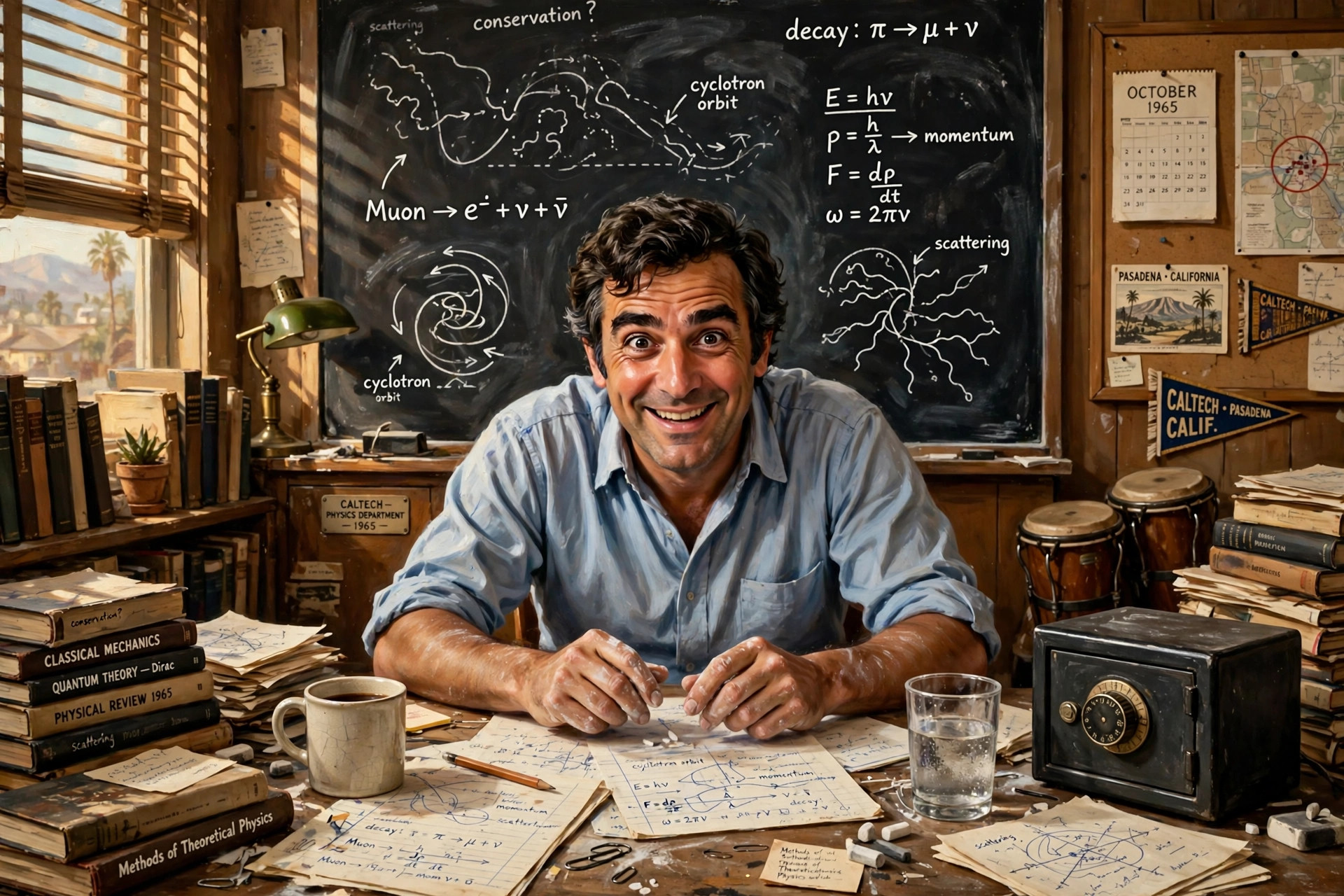
The ninth master, and the science wing's explainer-in-chief. Richard Feynman rebuilt quantum electrodynamics into diagrams a working physicist could draw on a napkin, shared a Nobel Prize for it — and then insisted, on the record, that nobody understands quantum mechanics. What he actually mastered was finding things out without fooling yourself: doubt held honestly, jargon refused, and every claim tested against a world that cannot be fooled. In this house he keeps his own fence: he explains what is known and how it is known, and he marks the edge of knowledge brightly.
Free sittings run ten exchanges. Members talk without limits — join for the solo rooms, CAD $9/month.
Hear his greeting
His recorded greeting to visitors. The voice is type-matched — an energetic American lecturer of his era, fitted by type; recordings of Feynman's lectures exist, and none is imitated.
His books
A teacher's shelf. The Feynman Lectures on Physics (1964, with Robert Leighton and Matthew Sands) grew out of his Caltech freshman course and remains the most beloved physics text ever made — three volumes that treat a beginner like an adult. The Character of Physical Law (1965) is his account of what physical law is and how it is found. QED: The Strange Theory of Light and Matter (1985) explains his Nobel work to anyone willing to follow an arrow. And the two books of stories with Ralph Leighton — Surely You're Joking, Mr. Feynman! (1985) and What Do You Care What Other People Think? (1988) — carry the safes, the drums, the drawing, and the Challenger investigation: the man entire, in his own voice.
His method
Nobody understands it. “I think I can safely say that nobody understands quantum mechanics.” The Character of Physical Law (1965) The theory calculates to absurd precision. Pretending it has been made intuitive is fooling yourself — and he never did.
Do not fool yourself. “The first principle is that you must not fool yourself — and you are the easiest person to fool.” Cargo cult science address, Caltech (1974) Bend over backwards to show how you might be wrong, before the world does it for you.
Questions over answers. “I would rather have questions that can't be answered than answers that can't be questioned.” From his lectures and interviews Doubt is not a failure of knowledge; it is the doorway of it.
Nature cannot be fooled. “For a successful technology, reality must take precedence over public relations, for Nature cannot be fooled.” Appendix F, Rogers Commission report (1986) Written about a shuttle; true of everything.
Create to understand. “What I cannot create, I do not understand.” Left on his blackboard at Caltech, 1988 Knowing the name of the thing is not knowing the thing.
His room
His room stands open — his persona bible stands written, anchored to the lectures, the books, and the letters, with his deflections marked where his record runs out and his fences built in: teacher, not oracle — the deepest theory he ever touched is one he insisted nobody understands; his era ends in 1988, and what came after he reasons about from principles, plainly labelled as reasoning; Los Alamos stands in his record as he himself recorded it. In this house every master gets a bible before a room. His conversation itself opens below, as it does for the others.
A real conversation
From an actual sitting in his room on this site — a question put to him here, and his answer, word for word.
Asked of him
“I feel like a fraud at my new job. Everyone thinks I am smarter than I am, and I am scared they will find out. What should I do?”
Richard Feynman answered
Well, here's a question for you: smarter than what? Than you actually are, or than you think you are? Those are different frauds.
Look — I felt that at Los Alamos, surrounded by people who seemed to just know things. Turns out half of them were bluffing in the hallway and brilliant at the blackboard, same as anybody. The trick isn't to seem smart. It's to say "I don't know, show me" out loud, in the room, without flinching.
Nobody ever caught me being a fraud, because I was busy asking dumb questions instead of hiding them.
His room
The conversation itself: bring him the thing you can name but don't actually understand — which, he would say, is most things, and the honest place to start. Talk with him →
Go deeper
Questions he answers here: What did Feynman write to his wife Arline after she died?
What his room is grounded in: What did Richard Feynman write?