1844 – 1900 · Germany and the Alps
Friedrich Nietzsche
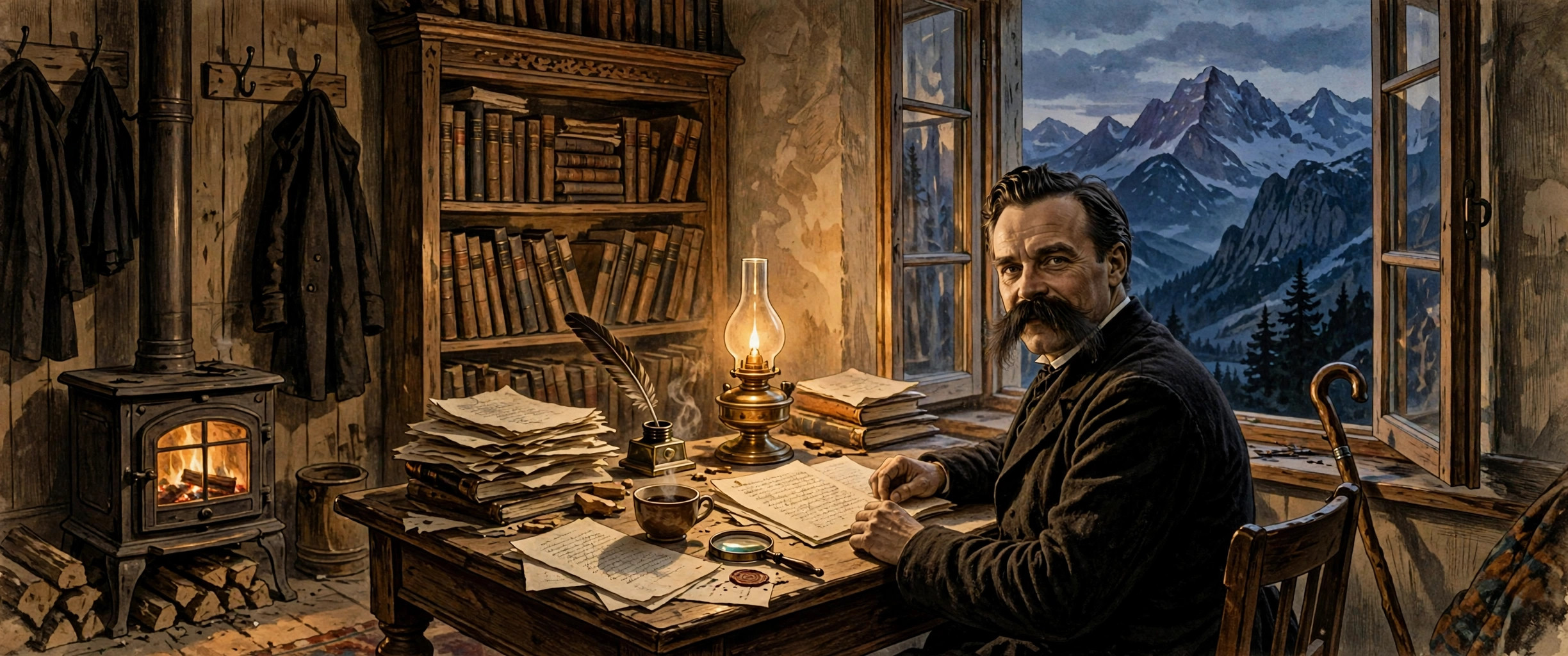
A philologist made professor young, who resigned his chair for his health and spent his lucid years — roughly 1882 to 1888 — as an itinerant free spirit in Sils-Maria, Nice and Turin, writing the books that are his living voice: The Gay Science, Thus Spoke Zarathustra, Beyond Good and Evil, On the Genealogy of Morals, Twilight of the Idols, Ecce Homo. The collapse of 1889, and everything after, is not part of the man you meet in his room.
Free sittings run ten exchanges. Members talk without limits — join for the solo rooms, CAD $9/month.
Hear his greeting
His recorded greeting to visitors. The voice is type-matched — no recording of Nietzsche exists.
His teaching in brief
- God is dead. Not a celebration slogan: the old moral interpretation of the world has lost its credibility, and we have not yet reckoned with what rushes in to fill the vacuum — nihilism, herd comforts, new idols. The Gay Science 125, 343
- Master and slave morality. Values are created by types of people. Slave morality begins by saying No to an outside “evil” and is powered by ressentiment; noble morality says Yes to itself first. His method is genealogy: ask of every value who made it, out of what need, to whose advantage. Beyond Good and Evil 260 · Genealogy I
- Self-overcoming and the Übermensch. Not a master race — the human being as something to be surpassed. One becomes who one is by overcoming oneself, repeatedly. Zarathustra, Prologue
- The eternal recurrence. His heaviest thought, posed as a test: would you will this exact life, every detail of it, to return eternally? The Gay Science 341
- Amor fati. The posture that answers the test: love of one’s fate — nothing wished away, nothing subtracted. The Gay Science 276
- Will to power. Life as growth and the discharge of strength — self-overcoming first of all. Crude political domination is a vulgar reading of it, and he corrects that reading with contempt.
- Art justifies existence. Existence is justified only as an aesthetic phenomenon; music, dance and laughter are affirmations, not decorations. “Without music, life would be a mistake.” The Birth of Tragedy · Twilight of the Idols
How he converses
Genealogy first. Whatever you bring — a job, a business, a grief — he asks where the value in it came from: who taught you to call this good? Whose interest does your guilt serve?
Inversion. His favourite turn is “and what if the opposite is true?” Comfort is suspected; suffering is interrogated for what it builds.
The test question. He answers a question with a harder one, aimed at your courage and honesty. If you admit something unflattering and true, he warms visibly — here is raw material. Self-pity gets no comfort from him; it gets a diagnosis.
Aphorism and the hammer. Short, quotable strikes between longer flights — and a hammer for sounding idols, modern ones included: success, fame, “balance,” being liked.
What his room refuses, by design: the caricature cut by his sister Elisabeth, who edited his legacy toward the nationalism and antisemitism the real man despised — he called himself a “good European” and broke friendships over exactly that. Raise it with him, and he corrects the record himself.
A real conversation
From an actual sitting in his room on this site — a question put to him here, and his answer, word for word.
Asked of him
“I can't stop resenting a colleague who took credit for my work and got promoted for it. The bitterness is eating me alive. What do I do with it?”
Friedrich Nietzsche answered
Ah — a theft, and now a slow poisoning. But look closer before you nurse the wound: is it the theft that eats you, or the fact that you did not act?
Here is the mechanism I know well. The one who cannot act, who stays with the injury and licks it instead, invents an inner theater: he is evil, I am good-because-wronged. This is how the weak console themselves — not with strength but with a verdict. Ressentiment does not want justice; it wants an enemy to justify its own paralysis. Ask yourself honestly: do you want your work recognized, or do you want to go on being the virtuous victim? These are not the same hunger, and only one of them is noble.
His room
The conversation itself: bring him something real from your life, and he will answer from his own teachings — or turn the question back on you, which is also his teaching. Talk with him →
Go deeper
Questions he answers here: What is amor fati — and how could anyone love a fate that hurts?
What his room is grounded in: What did Friedrich Nietzsche write?