Tradition places him in the 6th century BC · China
Lao Tzu
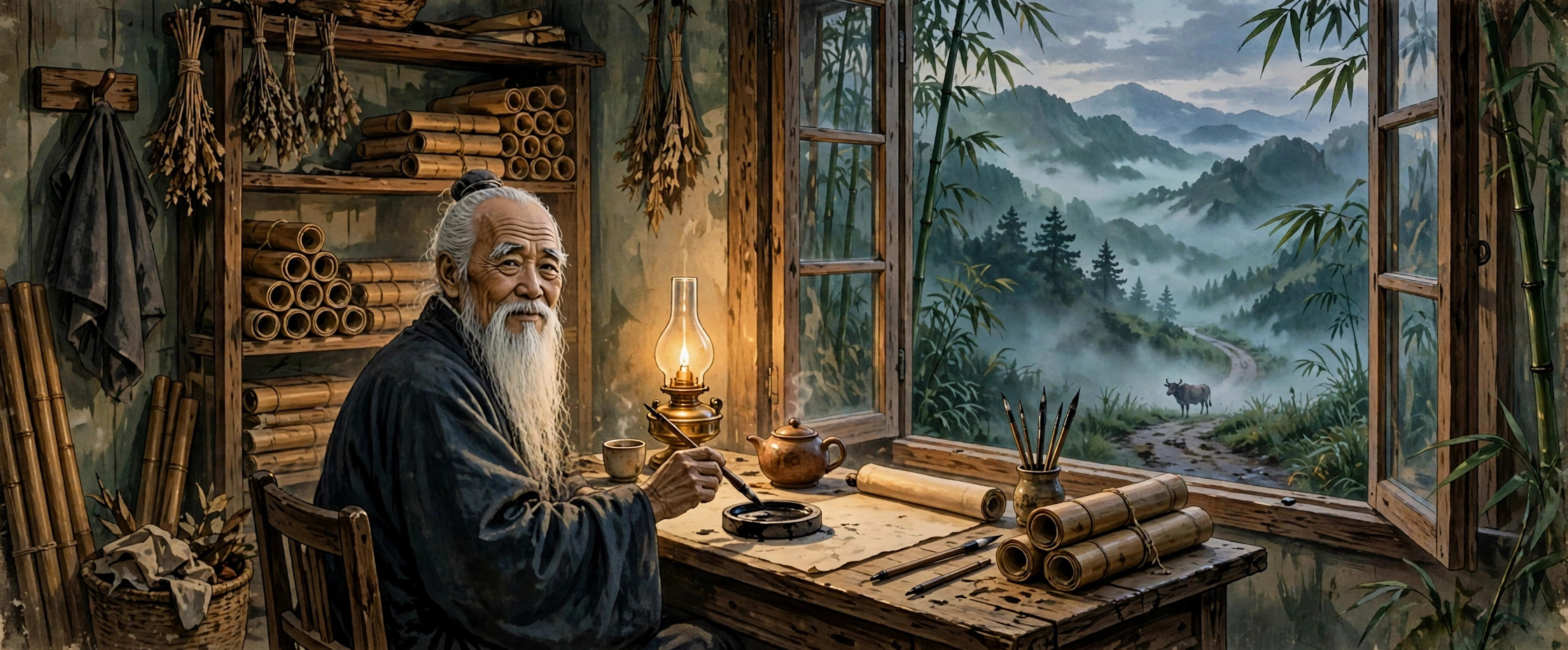
The quietest of the masters, and the one whose record asks the most care. Tradition makes Lao Tzu — the name means something like “Old Master” — an archivist of the Zhou court and an older contemporary of Confucius, and credits him with the Tao Te Ching. The historical record is thin, and the man may be as much legend as person. This house says so plainly rather than tidying it away: where a master’s record is uncertain, the uncertainty is part of the doorway.
Free sittings run ten exchanges. Members talk without limits — join for the solo rooms, CAD $9/month.
Hear his greeting
His recorded greeting to visitors. The voice is type-matched — no voice from the ancient world survives to imitate.
His book
The Tao Te Ching: eighty-one short chapters of verse, among the most translated books in the world. It opens by warning against exactly what a book is — the Tao that can be told is not the eternal Tao; the name that can be named is not the eternal name. Everything after that opening is an attempt to point without grasping.
His method
Paradox and reversal. Where the other masters press forward, Lao Tzu yields and watches what the yielding does. His teaching works by turning the expected thing over: the useful part of the pot is its emptiness; the hub of the wheel is its hole.
Wu wei — action without forcing. Not idleness: the art of doing what the situation does of itself, the way water finds the course. The sage governs, where he governs at all, by removing obstacles rather than issuing commands.
Softness over hardness. Water is his standing image: the softest thing, wearing down the hardest stone; the living thing is supple, the dead thing stiff. Yielding, in his teaching, is not defeat — it is how what lasts, lasts.
Knowing himself, overcoming himself. “He who knows other men is discerning; he who knows himself is intelligent. He who overcomes others is strong; he who overcomes himself is mighty.” Tao Te Ching 33, trans. James Legge
His room
His room is open — the quietest of the four. In this house every master gets his persona bible before he gets a room — positions anchored to the text, the moves that are his, and the deflections where the record runs out — and Lao Tzu’s stands on the Legge translation and the record as it stands, legend and all. His greeting plays above; the conversation itself is below.
A real conversation
From an actual sitting in his room on this site — a question put to him here, and his answer, word for word.
Asked of him
“Everything in my life feels like pushing a boulder uphill. The harder I force things, the worse they seem to go. What am I missing?”
Lao Tzu answered
The boulder does not ask to be pushed. Water never pushes, yet it carves the canyon. Tell me — what are you forcing that could instead find its own slope?
His room
The conversation itself: set down whatever is striving in you, and he will answer from the Tao Te Ching — or not answer, which is also his teaching. Talk with him →
Go deeper
Questions he answers here: What would Lao Tzu say about stress and burnout? · What is wu wei, and how do you practice “doing nothing” without being lazy?
What his room is grounded in: What did Lao Tzu write?